
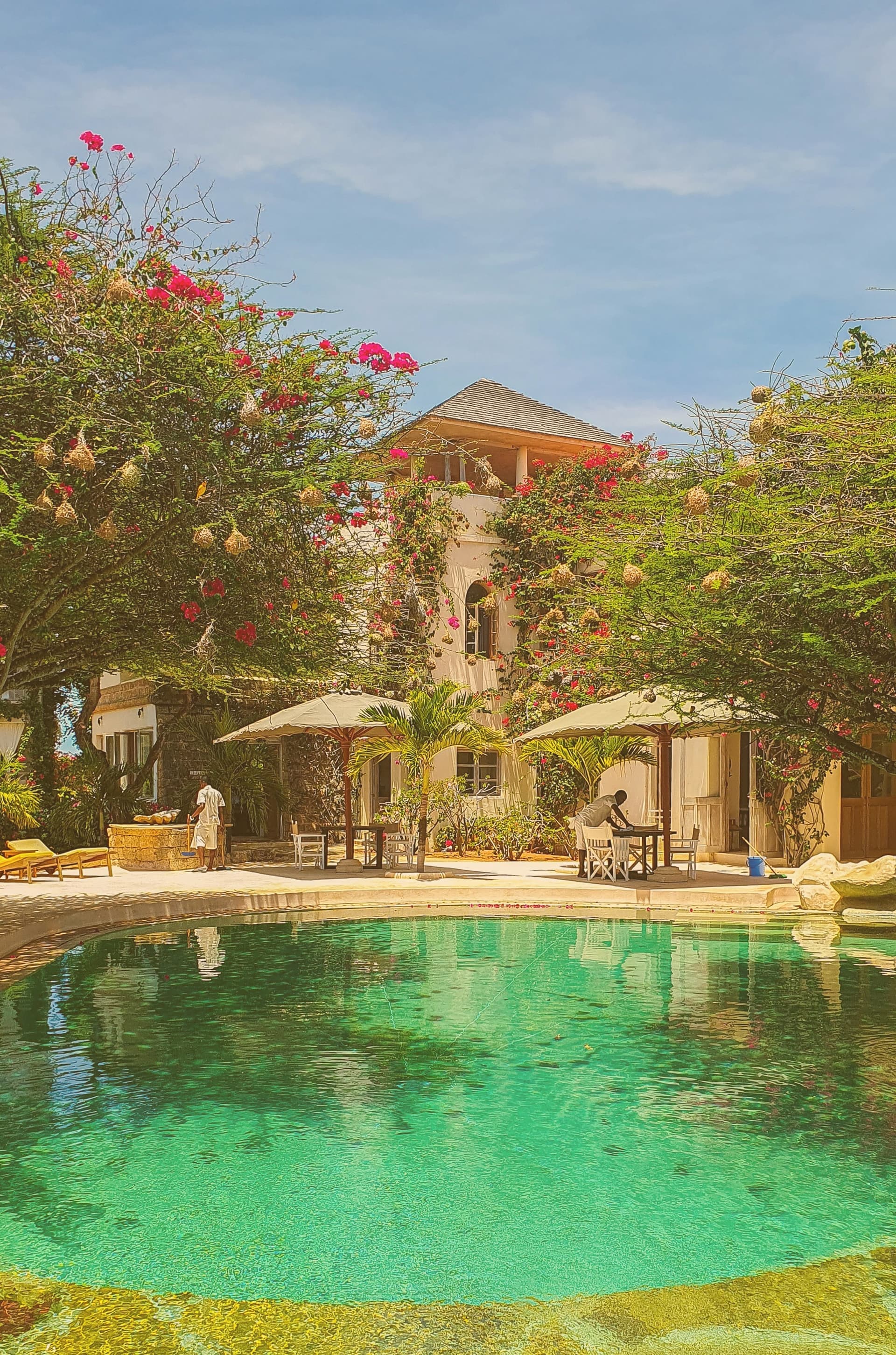
Lamu does not announce itself. It simply absorbs you.
The flight from Wilson Airport takes forty-five minutes — a small propeller aircraft banking over the ochre coast before descending onto a grass strip on Manda Island. A dhow is waiting. Not a tourist dhow — a proper working vessel, low and wooden, crewed by two men who have made this crossing ten thousand times.
The channel between Manda and Lamu Island is short, maybe fifteen minutes, but it is the kind of crossing that resets something inside you. The engine is a distant concern. The sail catches a wind you hadn't noticed before. And then the Lamu waterfront appears: a bleached coral facade stretching along the seagrass channel, unchanged in its essentials for six hundred years.
There are no cars in Lamu Town. The streets are precisely wide enough for a donkey and a human to pass side by side. This is not a charm offensive — it is simply the way the old city was built, and nothing about its internal logic has required updating. You navigate by walls and the smell of cardamom.
I spent four days here. The itinerary EscapePod had built was technically very light — a guide for the first morning, a snorkeling session at Manda Toto Island, a sunset dhow sail, and otherwise an empty calendar. This turned out to be exactly right.
The Majlis Hotel, where I stayed, is on the seafront. My room had a carved Swahili bed, a ceiling fan, and a window that opened onto the channel. I woke each morning to the first call to prayer, which comes just before dawn and is genuinely one of the most beautiful sounds a human can hear from a warm bed.
What Lamu teaches, if you stay long enough, is that silence is a texture. It has depth and variation. The silence at noon — when the heat pushes everyone indoors — is different from the silence of 3am, which is absolute. The silence of the mosque courtyard is different from the silence of the beach at Shela, where the wind and the surf create a kind of white noise that clears the mind completely.
I had not expected to think about my work, my phone, the particular ambient anxiety that constitutes modern life in a city. But I noticed on day two that I had stopped thinking about them. Not suppressed — simply replaced by other, slower things.
This is, I think, what EscapePod means by the Luxury of Zero Friction. It isn't that everything is perfect. It's that nothing requires your attention. The boat arrives when it should. The meal is ready. The guide knows when to speak and when to be quiet. The machinery of the trip runs invisibly, and you are left to simply be somewhere.
Lamu will not suit everyone. It has no air-conditioned malls, no nightlife in the conventional sense, no spa with a swim-up pool. What it has is a profound, almost physical stillness that is increasingly rare in the world. For four days, I lived inside it. I recommend it without reservation.